
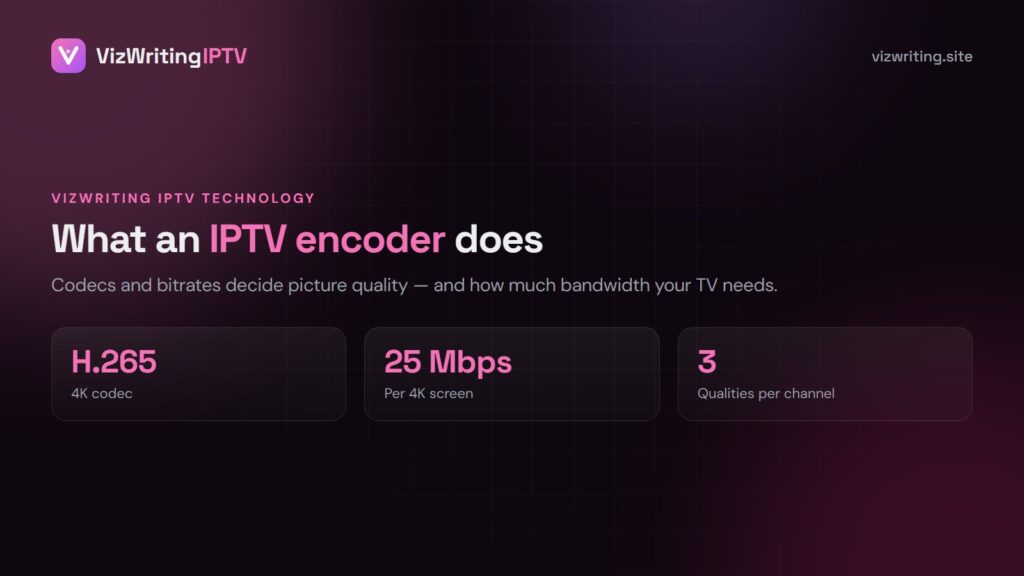
An IPTV encoder turns a TV signal into a compressed digital stream that can travel over the internet. The codec it uses and the bitrate it targets decide how sharp the picture is and how much bandwidth your TV needs.
From broadcast to your TV
- The channel is received from satellite, cable or a broadcaster feed.
- The encoder compresses it, usually with H.264 or H.265 (HEVC).
- Servers package the stream and send it to viewers.
- Your player decodes it on the TV or stick.
Codecs and bitrates
| Quality | Typical codec | Bitrate |
|---|---|---|
| HD 720p | H.264 | 3–5 Mbps |
| FHD 1080p | H.264 / H.265 | 5–10 Mbps |
| 4K 2160p | H.265 | 15–25 Mbps |
Swipe the table sideways to see every column.
Why it matters to you
- A 4K channel needs a device that decodes H.265 — most current sticks and TVs do.
- Higher bitrate means more bandwidth: plan on 25 Mbps for one 4K screen.
- That is why VizWriting IPTV offers 4K, FHD and HD copies of busy channels — pick the one your connection carries comfortably.
Frequently asked questions
Do I need an encoder to watch IPTV?
No. Encoders sit on the provider side; you only need a player app.
Why does a 4K channel stutter on my TV?
Usually bandwidth or an older decoder. Try the FHD copy or a cable connection.
What is HEVC?
H.265, a codec that gives the same picture as H.264 at roughly half the bitrate.
See the quality yourself. Test 4K and FHD channels on your own connection. See the VizWriting IPTV plans or ask for the free trial.
Ready to try VizWriting IPTV?
80,000+ channels in 4K, activation in minutes, a 7-day money-back window.
Leave a Reply